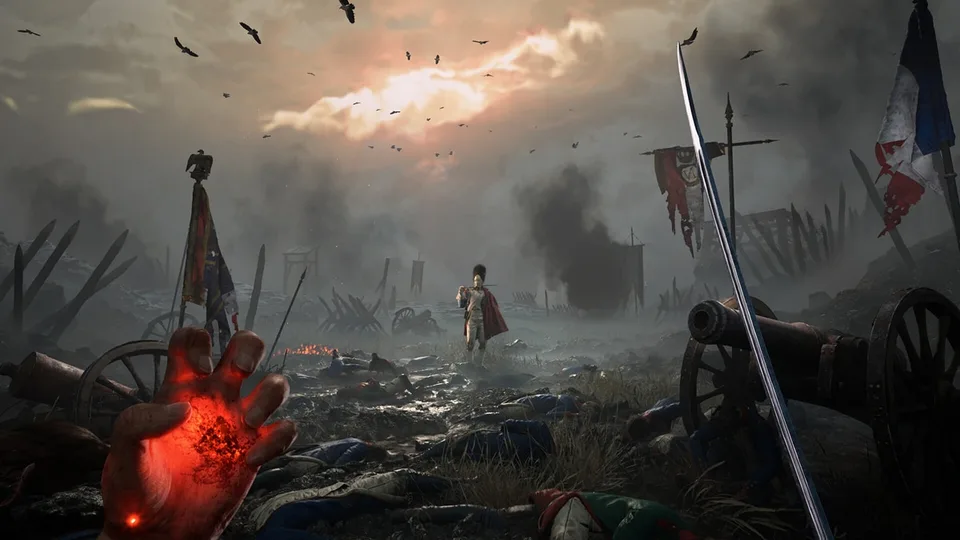
Valor Mortis Lore Explained: History, Alchemy, and the Napoleonic Nightmare
Dive into the dark lore of Valor Mortis. Explore the alternate history of the Napoleonic Wars, the mystery of the Crimson Plague, and the secrets of the Eternal Guard.
Published: Valor Mortis Wiki Editorial Team
Table of Contents
The Historical Foundation of Valor Mortis
Valor Mortis, developed by One More Level, is not just another Soulslike title; it is a meticulously crafted descent into an alternate history. While many games in the genre draw from high-fantasy tropes, this title grounds its narrative in the early 19th century. The premise is fascinating: it takes the real-world historical context of the Napoleonic Wars and infuses it with a terrifying, supernatural twist.
The developers have successfully pivoted from their previous work on Ghostrunner to create a first-person Soulslike experience that feels distinct. The game does not aim to be a history lesson, but rather uses the Napoleonic era as a canvas. The conflict is no longer just about territorial expansion or political dominance; it is about survival against a plague that has twisted the very soldiers who once fought for the Emperor into something inhuman.
Decoding the Lore: Napoleon and the Crimson Plague
The heart of the Valor Mortis narrative lies in the "Crimson Plague" and its alchemical origin, Nephtoglobin. The name itself is a significant lore clue. Breaking it down, the suffix "-globin" suggests blood-based components, while the prefix "Nephto-" hints at the Egyptian goddess Nephthys, associated with funerary rites and the night. This linguistic choice suggests that the game’s horror elements are not merely random; they are deeply tied to an ancient, esoteric form of alchemy.
Throughout the game, players will encounter environmental storytelling that suggests Napoleon’s obsession with the supernatural—specifically the myth of "L'Homme Rouge" (The Little Red Man)—led him to uncover these forbidden secrets during his Egyptian campaigns.
Nephtoglobin
A mysterious, alchemical substance that acts as the catalyst for the Crimson Plague. It is responsible for the reanimation of the fallen, turning soldiers into the Eternal Guard.
The Eternal Guard
Once the elite soldiers of Napoleon’s army, these combatants have been stripped of their mortality. They are sustained by Nephtoglobin, representing the transformation of the historical Imperial Guard into an undying, monstrous legion.
L'Homme Rouge (The Little Red Man)
A figure rooted in historical folklore surrounding Napoleon. In the context of Valor Mortis, this entity serves as a potential source for the arcane power Napoleon wields, bridging the gap between historical ambition and dark fantasy.
Understanding the Protagonist and the Eternal Guard
You step into the boots of William Dowsett, an English soldier whose presence in the Grande Armée is an immediate point of intrigue. Early gameplay reveals that despite being part of these ranks, William speaks French with a degree of unfamiliarity, suggesting a man out of time or place.
The enemies you face are not generic monsters; they are the remnants of a war machine that refused to die. The historical "Imperial Guard"—the battle-hardened veterans of Napoleon—have been twisted into the "Eternal Guard." This transformation is the visual representation of the game's core theme: the horror of war taken to an absolute, terrifying extreme.
Tip
Observing Environmental Cues: When exploring the Eastern Front settings, pay close attention to the uniforms of the enemies. You will notice they mirror 19th-century Russian military attire, providing clues about which specific campaigns Napoleon was pursuing when the plague consumed his forces.
Gameplay Mechanics as Narrative
In Valor Mortis, the gameplay mechanics are not separated from the lore; they are an extension of it. The "Transmutations" that William uses are explicitly described as alchemical abilities. This reinforces the idea that the magic system is not a generic "mana" pool but a manipulation of the same substance—Nephtoglobin—that caused the plague.
The progression system, which utilizes "Catalysts" to upgrade stats, also ties back to the alchemical theme. Players collect these items to improve their physical and magical capabilities, mirroring the protagonist’s need to harness the very power that is destroying the world to survive it.
How to Interpret Gameplay as Lore:
Analyze Your Magic: Recognize that "Transmutations" are alchemical processes. When you unleash a burst of flame, you are practicing the same dark arts that fueled Napoleon's rise.
Understand the Lanterns: The checkpoints, represented as lanterns, serve as the anchor for your resurrection. In the game's lore, this suggests a connection to the funerary rituals and the "light" that keeps the dead from fully passing on.
Manage Your Resources: Since ammunition for your flintlock pistol is scarce, it emphasizes the desperation of your situation. You are not a super-soldier; you are a survivor using limited, mundane tools against an overwhelming, supernatural force.
Behind the Vision: One More Level’s Approach
The team at One More Level has taken a bold approach by blending the fast-paced, first-person movement they mastered in Ghostrunner with the deliberate, high-stakes combat of a Soulslike. According to game director Radosław Ratusznik, the goal was to tell a "universal story about soldiers in the war," but through a lens of horror.
The transition from a publisher deal with Private Division to the current partnership with Lyrical Games did not deter the team’s vision. The game maintains a singular focus: delivering a cohesive, dark fantasy experience that respects the player's intelligence. They encourage players to question the world, to look for the "why" behind the monsters, and to challenge the assumptions of what a Soulslike game can be.
Key Narrative Elements to Track:
The distinction between historical events (like the invasion of Russia) and the alternate, plague-ridden version presented in-game.
The role of the Sphinx and Egyptian imagery as a signifier for the origins of the Crimson Plague.
The psychological state of William Dowsett as he navigates a world where his former allies are now mindless, undead monsters.
FAQ
Is Valor Mortis based on real history?
While the game utilizes historical figures like Napoleon Bonaparte and real-world military units like the Grande Armée, it is an alternate history. The events, particularly the Crimson Plague and the supernatural elements, are fictional and exclusive to the game's setting.
Who is the main character?
You play as William Dowsett, an English soldier serving in the Grande Armée. His background and his ability to navigate the plague-ridden world are central mysteries of the narrative.
What is the significance of the "First-Person Soulslike" tag?
This label refers to the game's mechanical focus: it combines the perspective and mobility of a first-person shooter with the combat philosophy of a Soulslike—where timing, stamina management, and learning enemy patterns are crucial to survival.
Does the game have a connection to the Ghostrunner series?
No. While Valor Mortis is developed by One More Level, the studio behind Ghostrunner, the two games are distinct properties with different settings and narrative universes.